
Women’s health is an increasingly important category within the food supplement industry, and few areas present as much opportunity for innovation as the menopause transition. For supplement brands and formulators, understanding the physiological changes women experience during perimenopause, and post-menopause is fundamental to developing products that address their evolving nutritional and wellbeing needs.
Menopause is no longer simply a conversation about hot flushes. Women are increasingly looking for solutions that address a broader range of concerns. This creates an opportunity for ingredient innovation, particularly around clinically researched botanical ingredients that target multiple dimensions of women’s health.
But to understand where the opportunities lie, we first need to understand what happens hormonally throughout the menopause transition.
Throughout the reproductive years, oestrogen and progesterone fluctuate naturally during the menstrual cycle. Oestrogen generally rises during the follicular phase, reaching a peak around ovulation, while progesterone increases during the luteal phase. Both hormones fall in the late luteal phase if pregnancy does not occur, triggering menstruation.
These cyclical changes can influence how women feel physically and emotionally.
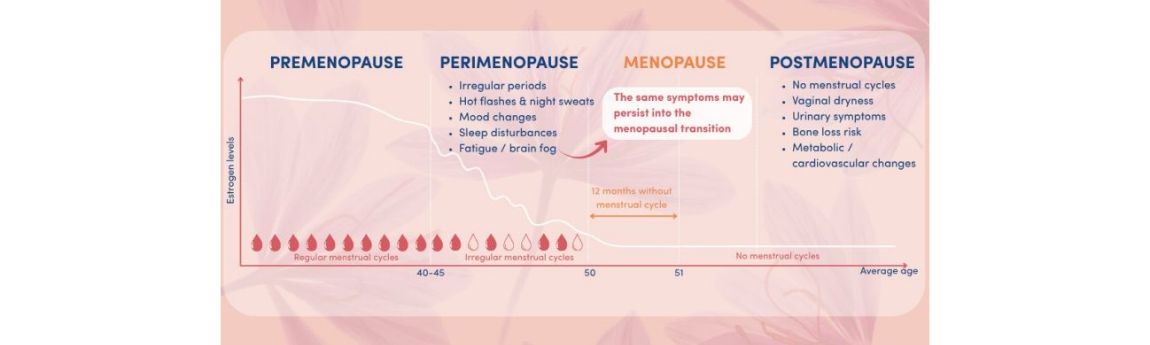
The menopausal transition is a gradual process, marked by changes in the balance of key reproductive hormones. During perimenopause, this hormonal pattern becomes less predictable with irregular menstrual cycles, until the body moves towards menopause, which is the point in time at which the body has not experienced a menstrual period for 12 months.
These hormonal changes can coincide with a range of physical and emotional symptoms than can start occuring during perimenopause but also persist during post menopause.
. During the overall menopausal transition, women may experience a variety of symptoms and the experience is not the same for every woman: symptoms vary in type and severity, and may change throughout the transition.
The transition continues into postmenopause during which other typical symptoms appear
. For women’s health supplement brands and formulators, understanding these stages and the range of symptoms associated with them provides a useful starting point for developing products that reflect women’s changing needs.
One of the biggest misconceptions surrounding the menopausal transition is that it is primarily associated with hot flushes.
In reality, the transition can influence several aspects of physical and emotional wellbeing.
Research indicates that 87% of postmenopausal women experienced at least one menopause-related symptom during their lifetime.
Reported symptoms include:
Symptom Reported prevalence
-Hot flushes 70%
-Sleep difficulties 67%
-Weight gain 63%
-Night sweats 51%
-Stress 37%
These findings highlight the diversity of consumer needs within the menopause category.
For brands, this presents an opportunity to move beyond single-symptom positioning and explore multifunctional formulations that address several aspects of women’s wellbeing. The challenge for formulators is identifying ingredients with relevant mechanisms of action and, ideally, clinical evidence supporting their intended applications.
One particularly interesting area of menopause research is the relationship between oestrogen and neurotransmitter activity.
Oestrogen interacts with several neurotransmitter systems, including serotonin, which plays an important role in mood and emotional regulation.
Changes in oestrogen levels during perimenopause may influence serotonergic signalling, potentially contributing to:
-Irritability.
-Mood fluctuations.
-Increased anxiety.
-Reduced emotional resilience.
-Changes in sleep and overall wellbeing.
This relationship highlights the importance of looking beyond hormonal levels alone when developing ingredients and formulations for women’s health.
Botanical ingredients that influence neurotransmitter pathways, stress responses and other interconnected physiological mechanisms are attracting increasing scientific interest.
Saffron (Crocus sativus L.) is one such botanical.
Safr’Inside™ is a patented saffron extract developed with a specific standardisation profile and characterised by its safranal and crocin content.
It contains:
-At least 0.2% safranal, measured by UHPLC (highest content on the market).
-At least 3% crocins, measured by UHPLC.
Its biological activity is supported by six demonstrated mechanisms of action, including modulation of:
-Serotonin pathways.
-Inflammatory processes.
-Cortisol response.
-Gut microbiota.
-Neuroprotection
-And activation of the relaxing nervous system
These mechanisms are particularly relevant when considering the interconnected physiological changes associated with perimenopause.
Rather than focusing exclusively on one symptom, Safr’Inside™ offers an interesting ingredient proposition for formulations targeting menopause. Importantly, its potential application in women’s health is supported by human clinical research specifically investigating its effects during the perimenopausal transition.
A randomised, double-blind, placebo-controlled clinical study investigated the effects of Safr’Inside™ supplementation on perimenopausal women.
Study design
The study involved:
-104 healthy women over 40 years of age.
-Participants presenting with typical perimenopausal symptoms.
-Daily supplementation with 30mg of Safr’Inside™ or placebo.
-A 12-week supplementation period.
The study evaluated outcomes at baseline, week six and week twelve.
Three validated assessment tools were used:
-Greene Climacteric Scale (GCS): Assessment of perimenopausal symptom severity.
-Profile of Mood States (POMS): Assessment of mood disturbances.
-SF-36: Assessment of health-related quality of life, including vitality.
Key clinical findings
The results demonstrated significant improvements across several important parameters from week 6.
Overall perimenopausal symptoms
The primary endpoint was the change in total Greene Climacteric Scale score.
The Safr’Inside™ group demonstrated a 68% reduction in overall perimenopausal symptom severity by week twelve, compared with a 17% reduction in the placebo group.
Night sweats
Night sweats reduced by 78% in the Safr’Inside™ group, compared with 24% in the placebo group.
Mood disturbances
Total mood disturbance, assessed using POMS, decreased by 30% in the Safr’Inside™ group, compared with 4% in the placebo group.
Vitality and energy
The SF-36 vitality score improved by 95% in the Safr’Inside™ group, compared with 19% in the placebo group.
These findings are particularly interesting from a product development perspective.
The study investigated several dimensions of the perimenopausal experience rather than focusing exclusively on one isolated symptom.
For brands developing women’s health supplements, this provides a clinical research foundation for exploring formulations targeting:
-Emotional wellbeing.
-Night sweats.
-Vitality and energy.
-Overall perimenopausal wellbeing.
The findings also support further investigation into the potential of saffron as a multifunctional botanical ingredient within the women’s health supplement category.
The menopause category is evolving.
As understanding of the hormonal transition improves, so does the opportunity to develop more targeted, evidence-led nutritional solutions that reflect the complexity of women’s changing health needs.
For supplement brands, the opportunity extends beyond traditional menopause support towards a more comprehensive approach to emotional wellbeing, vitality and sleep.
Understanding the underlying physiology, identifying relevant mechanisms of action and selecting ingredients supported by appropriate research will be essential to developing the next generation of women’s health supplements.
Safr’Inside™ brings together a standardised saffron extract, characterised biological activity and emerging clinical evidence in perimenopausal women, offering an interesting ingredient opportunity for brands looking to innovate within this growing category.
For further technical information, ingredient specifications and clinical research on Safr’Inside™, contact our team.